2026 PRICING EXPLAINER · INDIA RATE CARD
Meta WhatsApp Message Charges in 2026: The Complete Guide
Understand per-message billing, the latest October 2026 changes, Indian rates, free allowances, category rules and how to calculate your real WhatsApp messaging cost.
WhatsApp Business Platform pricing has changed significantly over the last few years. Businesses that once planned around a conversation-based fee moved to per-message billing in 2025. Then, on 1 October 2026, Meta introduced another important change: service replies became chargeable after a monthly free allowance, and utility template messages sent inside an open 24-hour customer service window became chargeable again.
For Indian businesses, these changes affect campaign budgets, customer support operations, order notifications, AI-assisted replies and the way WhatsApp providers explain their invoices. A low software subscription does not automatically mean a low messaging bill. You need to understand Meta's charge, your provider's fee and any additional markup separately.
This guide explains the current model using the India INR rate card effective 1 October 2026. It also explains how AdsEra handles message charges: AdsEra does not add a markup to Meta's WhatsApp messaging rates. Meta messaging fees remain separate from the AdsEra software subscription.
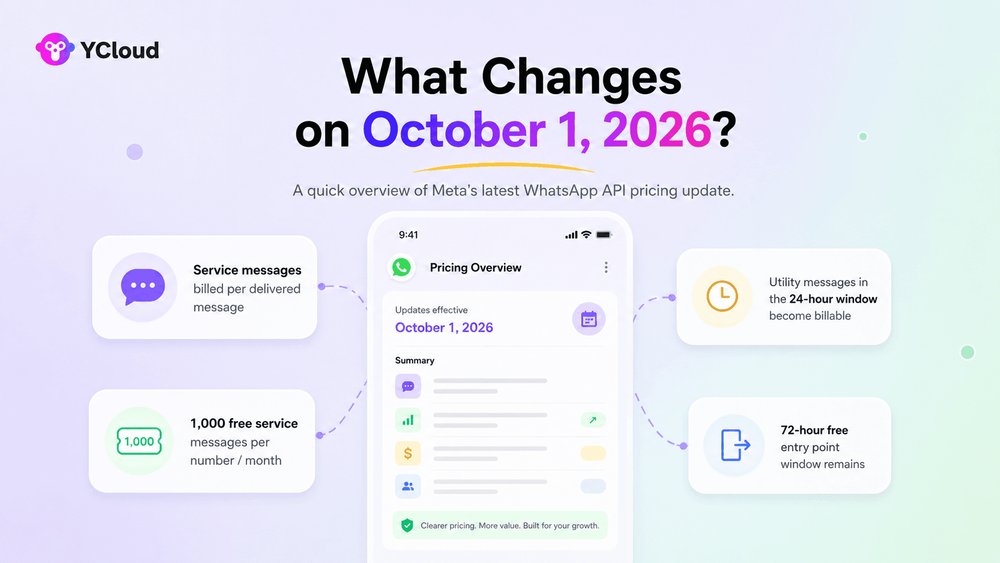
Pricing update illustration. Image source: YCloud.
The key numbers · India
Marketing
₹0.8631
Per delivered message
Utility
₹0.115
Per delivered template
Authentication
₹0.115
Per delivered template
Service replies
1,000 free
Per number/month, then ₹0.115
Meta list rates for messages delivered to Indian (+91) recipients, in INR, before applicable taxes and any separate software or provider fees. Service free allowance is shared by service replies on each business phone number.
1. How WhatsApp Business Platform pricing works
Meta charges businesses for eligible messages sent through the WhatsApp Business Platform. The amount depends primarily on the recipient's country or market and the message category. The message is charged according to the applicable rate when it is delivered; an undelivered message is not charged as a delivered message.
That means a business based in India sending a message to a customer in another country should not automatically use the India rate. The recipient's destination market determines the applicable market rate. The business's billing currency and account configuration determine how the charge appears on its bill.
Meta messaging charge = number of delivered billable messages × applicable Meta rate for the recipient's market and message category.
Meta's pricing documentation and published rate cards are the source of truth for rates and category rules. Providers may offer a platform subscription, support, automation, CRM or other software services around the API. Those software charges are separate from the underlying Meta message fee.
2. Meta's India WhatsApp message rates in 2026
The following is the India INR list-rate snapshot from the Meta rate card effective 1 October 2026. It is intended for messages delivered to Indian phone numbers (+91).
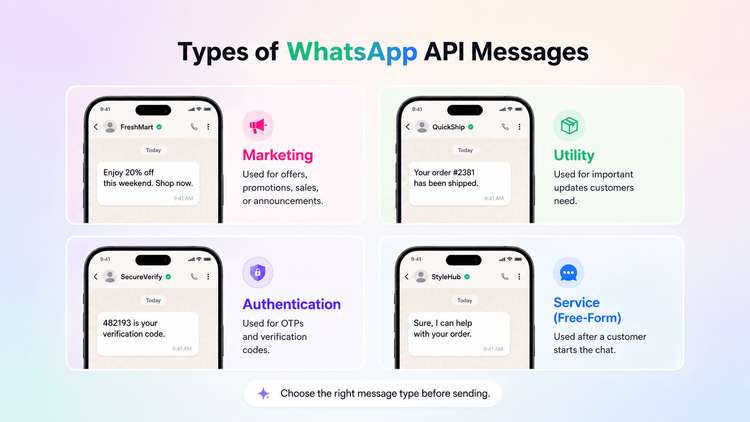
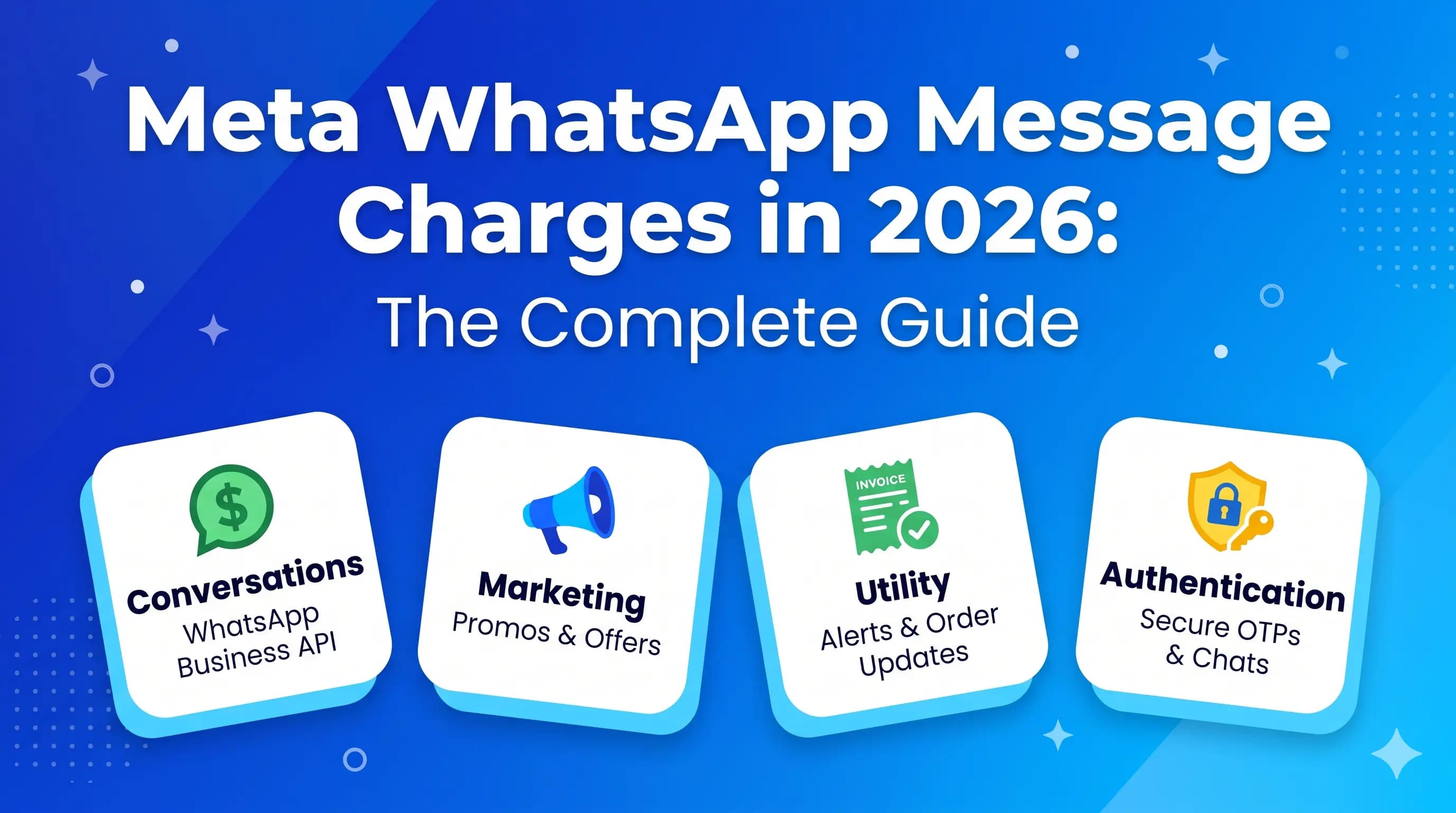
Message category examples. Image source: YCloud.
| Message category | Common use | Meta rate |
|---|---|---|
| Marketing | Promotions, offers, launches, re-engagement | ₹0.8631 |
| Utility | Order, booking, payment and account updates | ₹0.1150 |
| Authentication | OTP, login and verification codes | ₹0.1150 |
| Service | Non-template replies inside the 24-hour service window | 1,000 free per number/month, then ₹0.1150 |
| Authentication-International | Eligible international authentication use cases | ₹2.4971* |
*Authentication-International is a separate, eligibility-dependent rate. It is not the default price for every OTP. The standard India authentication list rate is ₹0.1150. Check Meta's current eligibility rules before applying the international rate.
Marketing costs about 7.5 times as much as a standard utility or authentication message at these India list rates. This is why accurate template categorisation and campaign planning matter. A promotional reminder cannot be made a utility message simply to obtain a lower price; Meta classifies templates based on their content and purpose.
3. What changed on 1 October 2026?
The most important 2026 pricing update took effect on 1 October 2026. It changed two message types that businesses had become accustomed to treating as free in certain circumstances.
CHANGE 01
Service replies are no longer unlimited-free
The first 1,000 delivered service messages per business phone number each month remain free. After that monthly allowance is used, additional service messages are charged at the market's service rate. In India, that rate is ₹0.115 per delivered service message.
CHANGE 02
Utility templates inside the 24-hour window are billable
A utility template sent while a customer's 24-hour service window is open is now charged at the utility rate. In India, that is ₹0.115 per delivered utility template, including when sent during the open window.
Before 1 October 2026, non-template service replies within the customer service window were free, and utility templates sent inside that window were also free under the previous per-message rules. The October update changed both treatments. Marketing and authentication templates were already paid categories, so the key change for many support teams is the new cost of service replies beyond the free monthly allowance and in-window utility templates.
| Message type | Before 1 Oct 2026 | From 1 Oct 2026 |
|---|---|---|
| Free-form service reply inside 24h | Free | First 1,000/month/number free, then charged |
| Utility template inside 24h | Free | Charged from the first delivered template |
| Utility template outside 24h | Charged | Charged |
| Marketing template | Charged | Charged |
| Authentication template | Charged | Charged |
| Customer's inbound message | No Meta message fee | No Meta message fee |
4. What exactly is a service message?
A service message is a business reply sent as a normal, non-template message while the customer service window is open. The 24-hour window opens when a customer messages the business and refreshes when the customer sends another message. During this window, the business can respond with free-form text and supported interactive messages without needing an approved template.
Service messages can be sent by a human agent, a chatbot or a third-party AI agent. The billing treatment is determined by the message type and applicable Meta rules—not simply by whether a human or AI wrote it. For India, the first 1,000 delivered service messages per business phone number per month are free. The next delivered service messages are charged at ₹0.115 each.
Service-message allowance: simple examples
| Service replies in the month | Billable replies | Meta cost in India |
|---|---|---|
| 600 | 0 | ₹0 |
| 1,000 | 0 | ₹0 |
| 1,600 | 600 | ₹69 |
| 5,000 | 4,000 | ₹460 |
| 10,000 | 9,000 | ₹1,035 |
Calculation: (service replies − 1,000 free messages) × ₹0.115, with a minimum of zero. This example assumes one business phone number and excludes taxes.
The free allowance is per business phone number, not an unlimited pool for an entire support team. If your business uses more than one number, check the usage and billing for each number. Unused free service messages do not create a cash credit; the allowance resets on the monthly cycle.
Inbound messages sent by customers are not charged as business-sent service messages. The service charge applies to the business's replies.
5. Why utility templates now cost money inside the 24-hour window
This is one of the easiest changes to misunderstand. The 24-hour customer service window does not make every WhatsApp message free. It permits free-form service replies, subject to the monthly service allowance. A utility template remains a template message and is charged at the utility rate even when the customer has recently messaged the business.
Consider a customer who writes, "Where is my order?" The support agent replies normally, "Your order is packed and will ship today." That non-template response is a service message. If the business instead sends an approved utility template with a transactional shipment update, it is a utility template and is chargeable at the utility rate.
NON-TEMPLATE REPLY
Service message
First 1,000 delivered service messages per number/month free; then ₹0.115 each in India.
APPROVED TEMPLATE
Utility message
₹0.115 per delivered utility template in India, including inside an open 24-hour window.
Do not try to avoid charges by changing a promotional message into a utility template. Utility content must be genuinely transactional, account-related or directly connected to something the customer requested or initiated. Promotional or mixed promotional content belongs in the marketing category. Meta can reject or recategorise templates that do not match the category rules.
6. The 24-hour customer service window explained
When a customer sends a message to your business on WhatsApp, a 24-hour customer service window opens. Each new customer message refreshes that window. While it is open, a business can send non-template service replies. Outside the window, a business generally needs an approved template to initiate or resume a conversation.
There are two separate questions to keep in mind:
- Messaging permission: Is the 24-hour customer service window open, or does the business need to use an approved template?
- Pricing: Is the message a service reply, utility template, marketing template or authentication template—and does a free allowance or special entry-point rule apply?
A window being open does not make all template messages free. In particular, the October 2026 change means utility templates are billed even inside the open window. The service-message allowance applies only to service replies, not to utility, marketing or authentication templates.
7. Special free-entry-point window from Click-to-WhatsApp ads
Meta also provides a separate free-entry-point mechanism for eligible conversations that begin when a user clicks a supported Click-to-WhatsApp ad or supported Facebook entry point and messages the business. When the business responds within the required customer service window, the eligible free-entry-point window can remain open for up to seven days under the updated rules.
This is different from the ordinary 24-hour customer service window and the monthly 1,000 service-message allowance. It is conditional on the supported ad or entry point and the required timely response; it should not be treated as a general free seven-day period for every WhatsApp conversation. Meta Business Agent usage, where applicable, follows its separate billing model.
For marketers running Click-to-WhatsApp campaigns, this can affect the total cost of a lead conversation. However, campaign spend on Facebook or Instagram ads is separate from WhatsApp messaging fees. A free messaging window does not mean the ad itself is free.
8. Meta Business Agent charges are separate from normal WhatsApp message charges
Meta's own Business Agent product has a separate token-based pricing model. The published rate card lists US$2.00 per one million tokens. That is not the same as the per-message service, utility, marketing or authentication fee, and it should not be confused with the fees charged for third-party AI tools.
Meta's pricing information describes token usage for the Business Agent's input and output processing. Its typical token use can vary with the length and complexity of a conversation. The rate card estimates that one million tokens is the billing unit; it does not mean every response has a fixed price. Check Meta's current Business Agent pricing details before forecasting this cost.
The token price applies to Meta Business Agent, not automatically to every AI assistant that sends WhatsApp messages. A third-party AI agent sending a normal non-template reply is generally treated under the applicable service-message rules; an approved template is billed according to its template category.
9. Worked cost examples for Indian businesses
These examples use the India list rates above, assume messages are delivered and exclude taxes, provider markups and software subscriptions. They are illustrative calculations—not a quote or an invoice forecast.
Example A: 10,000 marketing messages
| Delivered marketing messages | 10,000 |
| Meta India marketing rate | ₹0.8631 |
| Meta messaging fee | ₹8,631 |
Example B: 10,000 utility notifications
| Delivered utility templates | 10,000 |
| Meta India utility rate | ₹0.115 |
| Meta messaging fee | ₹1,150 |
Example C: 5,000 service replies from one number
| Delivered service replies | 5,000 |
| Monthly free service replies | 1,000 |
| Billable service replies | 4,000 |
| Meta messaging fee | ₹460 |
Example D: A mixed campaign and support month
Suppose one Indian business number delivers 6,000 marketing templates, 2,000 utility templates, 1,500 authentication templates and 1,400 service replies in a month.
| Category | Messages | Rate | Meta charge |
|---|---|---|---|
| Marketing | 6,000 | ₹0.8631 | ₹5,178.60 |
| Utility | 2,000 | ₹0.115 | ₹230.00 |
| Authentication | 1,500 | ₹0.115 | ₹172.50 |
| Service | 1,400 | 1,000 free; 400 × ₹0.115 | ₹46.00 |
| Total Meta messaging fees | ₹5,627.10 | ||
The exercise shows why message category mix matters. Marketing is the largest portion of the bill in this example. Service usage is comparatively small because the first 1,000 service replies for the number are free.
CLEARER WHATSAPP COSTS · ZERO PROVIDER MARKUP
Try AdsEra Today
Run WhatsApp campaigns and customer conversations without an additional AdsEra markup on Meta messaging fees. Your Meta charges and software subscription stay clearly separate.
10. Volume-based discounts: when can rates get lower?
Meta's October 2026 INR volume-tier schedule applies discounts to eligible utility and authentication messages as monthly volume increases. Marketing does not have the same volume-tier discount in this rate card, and service messages do not have volume-based tiers.
For India, the first utility volume tier begins only after 25 million delivered utility messages in the monthly volume band. The authentication volume tiers begin after 750,000 authentication messages. These thresholds are far beyond the monthly usage of most small and medium businesses, but they can matter to very large senders.
| Monthly category volume | Utility rate | Authentication rate | Discount |
|---|---|---|---|
| List-rate band | ₹0.1150 | ₹0.1150 | 0% |
| First tier after threshold | ₹0.1081 | ₹0.1081 | 6% |
| Second tier | ₹0.1012 | ₹0.1012 | 12% |
| Third tier | ₹0.0943 | ₹0.0943 | 18% |
| Fourth tier | ₹0.0874 | ₹0.0874 | 24% |
| Highest tier | ₹0.0805 | ₹0.0805 | 30% |
India's October 2026 monthly bands are different for each category. Utility: 0–25,000,000 messages at list rate; 25,000,001–50,000,000 at ₹0.1081; 50,000,001–100,000,000 at ₹0.1012; 100,000,001–200,000,000 at ₹0.0943; 200,000,001–300,000,000 at ₹0.0874; and 300,000,001+ at ₹0.0805. Authentication: 0–750,000 at list rate; 750,001–15,000,000 at ₹0.1081; 15,000,001–20,000,000 at ₹0.1012; 20,000,001–50,000,000 at ₹0.0943; 50,000,001–100,000,000 at ₹0.0874; and 100,000,001+ at ₹0.0805. Authentication-International has its own separate tier schedule. Check Meta's current rate card before forecasting very high monthly volumes.
11. Meta's pricing is not the same as your WhatsApp provider's total bill
This is where businesses can misread their WhatsApp costs. Meta sets the underlying message fees. A WhatsApp platform provider may separately charge for its software, team seats, AI usage, integrations, onboarding, premium support or other services. Some providers may also add a markup to Meta's messaging fees.
Always separate these line items:
| Bill component | What it means |
|---|---|
| Meta message fee | The applicable Meta rate for delivered messages by category and recipient market. |
| Provider message markup | An additional per-message amount charged by a provider on top of Meta's rate, if that provider applies one. |
| Platform subscription | The software plan for access to inbox, campaigns, automation, CRM or other features. |
| Optional usage and add-ons | Any separately priced AI usage, extra seats, channels, integrations or premium services. |
| Taxes | Applicable taxes shown under the relevant billing arrangement and invoice. |
A provider quote that says "WhatsApp messages at Meta rates" should be backed by a clear rate card or itemised invoice. Ask whether the provider passes on Meta's rate exactly or adds a separate per-message margin.
12. AdsEra message pricing: zero markup on Meta charges
ADSERA PRICING POSITION
0% markup on Meta WhatsApp message charges
AdsEra does not add an additional provider markup to Meta's WhatsApp messaging rates. The applicable Meta message fee remains separate from the AdsEra software subscription.
For businesses planning regular broadcasts, automated journeys or high-volume customer conversations, a message markup can add up over time. A transparent pricing model makes it easier to forecast campaigns and compare providers fairly.
Example: 10,000 delivered marketing messages
| Meta rate (India) | ₹0.8631 |
| Meta message fee | ₹8,631 |
| AdsEra message markup | ₹0 |
| Meta messaging amount before tax | ₹8,631 |
This illustration excludes applicable tax and AdsEra's separate software subscription. It assumes 10,000 successfully delivered marketing messages to Indian recipients at the published list rate.
What this means: You can evaluate AdsEra's software subscription and capabilities separately from Meta's message charges. There is no additional AdsEra per-message markup being added to the Meta rate.
AdsEra's value is not just about message pricing. It brings WhatsApp broadcasts and workflows together with Addy AI, CRM, Closer, Prospects, summaries, calling and integrations—helping businesses manage the work that happens before and after a message is delivered.
AI engagement and lead qualification.
Contacts, deals and sales pipelines.
Follow-up planning and a prioritised rep queue.
Messaging workflows and configured conversion feedback.
FROM MESSAGE DELIVERY TO SALES ACTION
Make every WhatsApp conversation count
Try AdsEra Today and explore Addy AI, CRM, Closer, Prospects, broadcasts and workflows in one connected WhatsApp growth platform.
13. How to reduce your WhatsApp messaging bill
You cannot change Meta's published rate, but you can improve the way your business uses WhatsApp. The goal should be to spend on messages that are relevant, expected and useful to the customer.
- Segment marketing audiences. Avoid sending every campaign to every contact. Target the right audience and suppress customers who are not relevant to the offer.
- Monitor category mix. Marketing is materially more expensive than utility or authentication at India's list rates. Keep transactional and promotional use cases clearly separated.
- Use utility templates correctly. Utility is for genuine order, booking, account or transaction updates. Do not disguise marketing content as utility to chase a lower rate.
- Track your service-message allowance. Monitor the first 1,000 free service replies per number each month and the volume beyond that allowance.
- Improve first-contact resolution. Help customers find accurate answers quickly so conversations do not become unnecessarily long or repetitive.
- Use automation thoughtfully. Automate repetitive answers and routing, but make sure AI replies are relevant and useful. A message sent by an AI through a third-party platform is not automatically exempt from the service-message rules.
- Measure delivered messages. Reconcile message delivery reports with the invoice. The pricing basis is delivered messages, not simply the size of the uploaded contact list.
- Review provider invoices. Check for a separate per-message markup, seats, platform fees, AI usage and other add-ons.
- Use Click-to-WhatsApp campaigns strategically. Understand the free-entry-point conditions and respond in time to activate the eligible window.
- Forecast before launch. Estimate costs by category, recipient country and delivered volume rather than using one blended average price.
14. Common mistakes businesses make about WhatsApp charges
| Common misunderstanding | What to remember |
|---|---|
| "Every reply within 24 hours is free." | Only service replies get the monthly free allowance. Utility templates are now billable even inside the 24-hour window. |
| "The first 1,000 free messages cover every category." | The allowance is only for service messages and is counted per business phone number each month. |
| "AI replies are always free." | Third-party AI service replies follow the applicable service-message pricing rules. Meta Business Agent has its own token billing. |
| "A utility template is cheaper, so I can label any message utility." | Meta classifies templates by content and purpose. Promotional or mixed-purpose content can be classified as marketing. |
| "My provider's subscription includes Meta messages." | A software subscription and Meta's message charges are separate unless the provider's contract clearly states otherwise. |
| "Meta charges the same rate for every country." | Rates vary by recipient market and category. Use the correct rate card for the destination country. |
15. Frequently asked questions
How much does Meta charge for WhatsApp messages in India in 2026?
On the INR rate card effective 1 October 2026, the list rates for Indian recipients are ₹0.8631 per marketing message, ₹0.115 per utility message and ₹0.115 per authentication message. Service replies have 1,000 free delivered messages per business phone number per month, then cost ₹0.115 per additional delivered reply.
When did Meta introduce the new service-message charges?
The service-message charging update took effect on 1 October 2026. The first 1,000 delivered service messages per business phone number each month remain free; additional service messages are billed at the applicable market rate.
Are WhatsApp replies within 24 hours free now?
Not all replies. Normal non-template service replies have a monthly free allowance of 1,000 per business phone number. After that, each additional delivered service reply is charged. Utility templates are billable even during the 24-hour customer service window.
Are inbound WhatsApp messages charged?
Customer messages sent to a business are not billed as business-sent service messages. Meta's message charges apply to eligible messages sent by the business.
Does the 1,000-message free allowance apply to marketing templates?
No. It applies only to service messages. Marketing, utility and authentication templates are billed according to the applicable category rate and recipient market.
Are AI chatbot replies charged?
A third-party chatbot or AI agent sending a non-template response within the customer service window is generally treated as a service message. The first 1,000 service messages per number each month are free, with additional messages billed at the applicable service rate. Meta Business Agent is a separate Meta product with token-based pricing.
Does Meta charge for undelivered WhatsApp messages?
Meta's per-message billing is based on delivered messages. A message that is not delivered is not charged as a delivered message under the standard pricing model. Check delivery status and the billing details in your account.
Does AdsEra add a markup to Meta WhatsApp message charges?
No. AdsEra does not add a provider markup to Meta's WhatsApp messaging rates. Meta's applicable messaging fees are separate from the AdsEra software subscription and any applicable taxes.
Is the Click-to-WhatsApp ad conversation free?
Eligible Click-to-WhatsApp or supported Meta entry-point conversations can receive a separate free-entry-point messaging window, potentially up to seven days when the business meets Meta's conditions, including responding within the required time. Ad spend is separate, and this is not a blanket free period for every WhatsApp chat.
Do these charges apply to the regular WhatsApp Business app?
The per-message pricing described here applies to the WhatsApp Business Platform/API. The regular WhatsApp Business mobile app used without the API is a different product. Businesses using API-connected software, automation or a shared inbox should confirm how their specific setup is billed.
Where can I check the latest WhatsApp rates?
Use Meta's official WhatsApp Business Platform pricing documentation and the current rate card for your billing currency. Rates and pricing rules can change, so confirm them before planning a major campaign or renewing a provider contract.
16. Final takeaway: know Meta's rate, know your provider's markup
Meta's WhatsApp pricing is now a per-delivered-message model, with different rates for marketing, utility, authentication and service messages. The 1 October 2026 changes are particularly important: service replies are free only up to 1,000 per phone number each month, and utility templates are chargeable even while a customer service window is open.
For Indian businesses, the current INR list rate card shows ₹0.8631 for marketing and ₹0.115 for utility and authentication messages. Service messages cost ₹0.115 after the monthly free allowance. Always check the recipient market, category and current Meta rate card before estimating costs.
With AdsEra, there is no extra provider markup on Meta's message fees. You pay the applicable Meta messaging charge without an additional AdsEra per-message margin, while the AdsEra software subscription remains a separate line item. That makes it easier to understand the difference between messaging cost and the tools your team uses to run campaigns, automate engagement and convert leads.
GROW WITH CLEARER WHATSAPP COSTS
Run WhatsApp marketing without an extra message markup
Explore AdsEra's WhatsApp campaigns, Addy AI, CRM, workflows and sales follow-up tools—with zero additional AdsEra markup on Meta messaging fees.
Explore AdsEraSources and rate-card references
- Meta: Pricing on the WhatsApp Business Platform — current pricing model, rates and billing rules.
- Meta: Non-template message pricing updates — service messages and related pricing rules.
- Meta: WhatsApp pricing volume tiers — how eligible utility and authentication message volume tiers work.
- INR rate-card document, effective 1 October 2026 — published India rates and volume tiers; consult Meta's live pricing documentation for the authoritative current version.
- Meta: WhatsApp business platform updates, July 2025 — platform and marketing workflow context.
Editorial and pricing note: This article is published by AdsEra. AdsEra's zero-markup statement refers specifically to an additional AdsEra provider markup on Meta WhatsApp message fees; it does not mean Meta messages are free or that the AdsEra subscription, taxes or separately priced services are waived. Rates in examples are India INR list rates effective 1 October 2026 and exclude taxes. Other recipient markets and account billing currencies may use different rates. Verify all rates, category rules, volume thresholds, free-entry-point eligibility and billing terms with Meta before purchase. This article is an informational guide, not a tax or billing statement.